
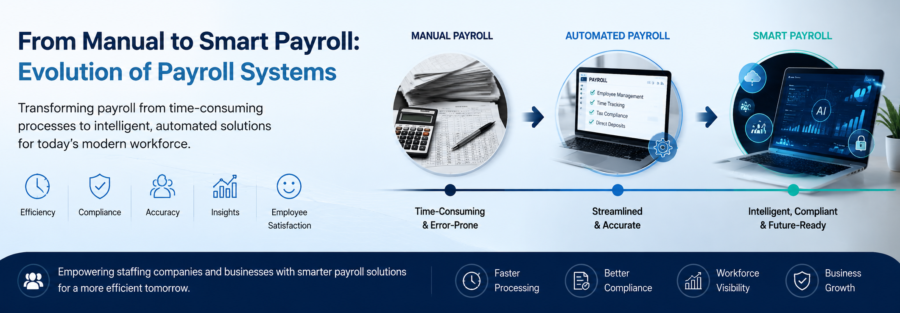
Payroll has undergone a remarkable transformation over the decades, shifting from time-consuming manual processes to intelligent, automated ecosystems. For staffing companies and businesses managing large workforces, this evolution of payroll systems has not just improved efficiency—it has redefined compliance, accuracy, and employee experience.
The Early Days: Understanding Manual vs Automated Payroll

In the early stages, payroll was entirely manual. HR teams relied on paper timesheets, handwritten calculations, and physical record-keeping. Every paycheck required meticulous effort—calculating hours, deductions, taxes, and benefits individually. While this system worked for smaller organizations, it was highly prone to errors, delays, and compliance risks.
The biggest drawback of manual vs automated payroll lies in scalability. As businesses expanded, manual payroll became unsustainable. Staffing agencies, in particular, struggled to manage high-volume, variable workforce payments across multiple client accounts. Even a minor miscalculation could lead to compliance issues or employee dissatisfaction.
The Shift Toward Automation in Payroll
The transition from manual systems to automated payroll began with basic software solutions. These tools helped digitize calculations and record-keeping, reducing human error and improving processing speed. Over time, automation evolved into cloud-based payroll platforms capable of handling complex requirements such as multi-state tax compliance, benefits administration, and contractor payments.
This phase marked a critical milestone in the evolution of payroll systems. Businesses began to realize that payroll was not just an administrative task—it was a strategic function tied to employee trust and operational efficiency.
Smart Payroll Systems: The Modern Approach
Today’s payroll systems go far beyond automation. Smart payroll systems integrate advanced technologies like AI, real-time data processing, and analytics to deliver accurate and compliant payroll operations. These systems can automatically update tax regulations, flag discrepancies, and provide insights into workforce costs.
For staffing companies, smart payroll solutions are especially valuable. Managing temporary, contract, and full-time employees across different jurisdictions requires flexibility and precision. Automated systems streamline onboarding, time tracking, and payment processing—all within a unified platform.
The comparison of manual vs automated payroll clearly highlights the advantages of modern systems:
- Reduced administrative burden
- Faster payroll processing cycles
- Improved compliance management
- Enhanced employee satisfaction
- Better workforce visibility and reporting
How Technova Global Payroll Services Support Businesses
To help businesses adapt to the changing payroll landscape, Technova Global Payroll Services delivers scalable and technology-driven payroll solutions tailored for modern workforce management. From handling multi-state payroll compliance and automated salary processing to managing contractor payments and employee records, Technova helps organizations reduce payroll complexity and improve operational efficiency. By leveraging advanced automation and compliance-focused processes, businesses can minimize payroll errors, ensure timely employee payments, and focus more on strategic growth rather than administrative tasks. For staffing companies and enterprises managing diverse teams, Technova’s payroll expertise supports seamless and accurate workforce operations.
Compliance and Accuracy: A Key Driver of Evolution
One of the primary reasons behind the evolution of payroll systems is the increasing complexity of labor laws and tax regulations. In the U.S., businesses must comply with federal, state, and local requirements—each with its own rules and deadlines.
Manual systems often fail to keep up with these changes, leading to penalties and reputational risks. Automated payroll solutions, on the other hand, are designed to stay updated with regulatory changes, ensuring compliance without additional effort from HR teams.
The Role of Payroll in Staffing and Workforce Management
In the staffing industry, payroll is more than just paying employees—it is a core component of service delivery. Clients expect accurate billing, timely payments, and transparent reporting. Smart payroll systems enable staffing companies to meet these expectations while maintaining profitability.
By leveraging advanced payroll technologies, staffing firms can focus on strategic growth rather than administrative challenges. This shift represents the true impact of the evolution of payroll systems—turning payroll from a back-office function into a competitive advantage.
Looking Ahead: The Future of Payroll
The future of payroll lies in further integration and intelligence. With advancements in AI and machine learning, payroll systems will become even more predictive and personalized. Businesses can expect features like:
- Real-time payroll processing
- Automated compliance audits
- AI-driven payroll analytics
- Deeper workforce insights
- Integrated HR and payroll ecosystems
As organizations continue to grow and diversify, the debate around manual vs automated payroll will become increasingly one-sided. Automation is no longer optional—it is essential for efficiency, accuracy, and scalability.
Conclusion
In conclusion, the evolution of payroll systems reflects the broader digital transformation of business operations. For companies aiming to stay competitive, adopting smart payroll solutions is not just a technological upgrade—it is a strategic necessity. Businesses that embrace automated payroll systems can improve compliance, streamline workforce management, reduce operational risks, and deliver a better employee experience in an increasingly fast-paced business environment.